Ideas & guides · Halloween
How to Decorate a Corner Lot for Halloween
You are on a corner. Do you decorate the front, the side, or both, and how do you do both without buying twice as much?
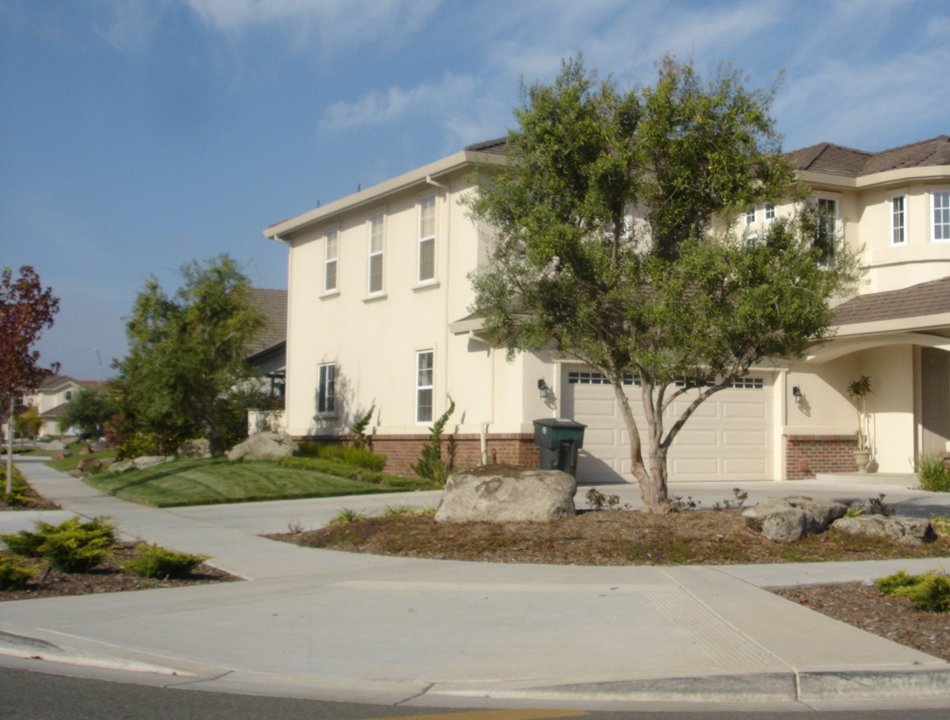
Treat the corner itself as the front. The junction of the two streets is where cars stop and where the largest number of people look for the longest time, and it is the square footage nearly every corner lot leaves empty. Anchor there and work back along both frontages, rather than decorating a front door that half your audience never faces.
6 minute read.
The corner is the most-seen ground you own
Every vehicle that comes to a stop at the intersection stops with the driver looking directly at your corner, and it stops for several seconds rather than passing at twenty miles an hour. Pedestrians turn there. It is, measured in eyeball-seconds, the most valuable ten feet on the property.
It is also, on almost every corner lot, completely empty grass. The decorations are up by the door because that is where the house is and that is where the outlet is.
So the first move is not buying anything. It is walking to the corner, standing in it, and looking back at your own house to see what people who stop there are actually given.
Most towns regulate how tall anything can be near an intersection so drivers can see across the corner. It is usually called a sight triangle, sight distance or vision clearance, the height limit is commonly around three feet within a triangle measured back from the junction, and the exact numbers vary by municipality. Look up your own before you put a six foot prop in the corner. Low and good is the aim anyway, and this is one of very few decorating decisions with a genuine safety consequence.
This is the shape
Both frontages, drawn to scale
Corner Lot, 60 ft of frontage, The Old Cemetery at One nice thing. 8 spots filled, $485.89 of a $500 ceiling.
Street along the bottom and street along the left. The spots run around the corner rather than clustering at the walk, and the side frontage carries real weight instead of being treated as the back of the display.
How to cover two frontages without buying twice
The instinct is that two frontages need two displays. They do not, because the two arcs of view overlap at the corner: a piece placed near the junction is working for both streets at once, all evening, for the price of one.
So the priority order goes corner first, then the walk, then the side frontage, then the far end of the front. The pieces nearest the corner earn double and should be the best ones you own.
Linear things are the cheap way to make the side frontage read. A lit fence line, a run of path stakes along the sidewalk, or a row of low stakes carrying the theme costs very little per foot and gives forty or fifty feet of side yard something to be, without needing another centrepiece.
And turn the flat props. On a corner lot anything cut from a sheet is being seen from two directions, so it wants to be angled into the junction rather than squared up to the front wall of the house.
Where the money should go
| Position | Priority | Why |
|---|---|---|
| The intersection corner | First | Seen by both streets, by stopped traffic, for longer than anywhere else. Keep it under the local height limit. |
| Along the side frontage | Second | The half everybody skips. Linear lighting does this cheaply; it does not need its own centrepiece. |
| The walk and front door | Third | Genuinely important on the one night, because it is where callers actually go. |
| The far front corner | Last | Seen briefly, from one direction, by people already past the good part. |
Where this usually goes wrong
Leaving the side street bare
Forty to seventy feet of frontage with nothing on it, facing half the traffic. It does not need a second display, it needs a lit line: fence, path stakes or low markers along the sidewalk.
Putting something tall in the corner
The most-seen spot is also the one your town most likely regulates, because drivers need to see across it. Check the local sight triangle rule and keep the corner low. Low is the better look there anyway.
Squaring the flat props to the house
On two frontages a cut-out facing the front wall is edge-on to the side street. Angle anything flat toward the junction, where both viewing arcs overlap.
The corner lot is one of the ten shapes on this site, planned with both frontages and the corner treated as the primary spot rather than as leftover lawn.
Plans drawn for this shape
Every one of these is the same Corner Lot at 60′ by 25′, with 12 spots to fill. The map, the yard notes and the do-it-yourself version are free on all of them.
Halloween: Alien Invasion · Cryptid Crossing · The Old Cemetery · Spiders, Spiders, Spiders · Toxic Waste · Witch's Brew · Zombies
Christmas: Christmas Tree Forest · Classic White Christmas · The North Pole · Nutcrackers · Reindeer Pen · Santa's Workshop · Under The Tree · Vintage Christmas · Winter Wonderland
Valentine's Day: Cupid's Bow · Lace Valentine's Day · Sparkle Hearts
Easter and Spring: Easter Bunny Visit · Eggs, Eggs Everywhere · Spring Flowers
Read next
One-Sided Props Have a Back, and Somebody Always Sees It
Flat props look superb from one angle and like a sheet of plywood from every other. On a corner lot or a long driveway, every other angle is most of them.
Read itHow to Decorate a Small Front Yard for Halloween
Under 30 ft of frontage is not a problem to work around. It is closer to the street, which is the one advantage a big lawn cannot buy.
Read itDo Fog Machines Actually Work Outdoors?
Yes, on a still night, through ice. Straight out of the box on a breezy one it is twenty seconds of grey cloud drifting into next door.
Read itmore like this
New guides go up through the season
Each one is a lot shape or a problem worked all the way through, the same as this one, and they are all free to read. No schedule worth promising, but they keep coming.